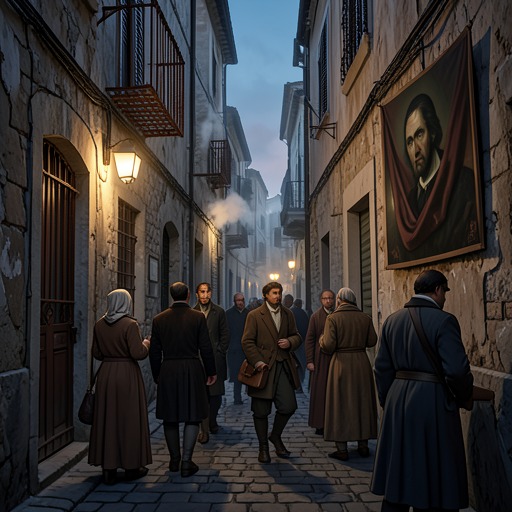
Jealousy
Much Ado About NothingJealousy in Much Ado About Nothing is not merely an emotion of romantic possession; it is a way of reading appearances that transforms suspicion into conviction. The concept emerges through competing judgments of Claudio and the Count, through Don John’s deliberate manufacture of sexual dishonor, and through Borachio’s later account of how darkness, sworn testimony, and deliberate villainy combined to make a false accusation seem true. Jealousy therefore becomes both a private disturbance and a public instrument of deception: it damages honor, redirects marriage, and drives Claudio toward theatrical punishment before the supposed evidence has been properly tested.
Jealousy as a Visible Disposition
The first appearance of jealousy is indirect and diagnostic. Beatrice describes the count as neither sad nor sick, merry nor well, but as a “civil count,” “civil as an orange,” possessing something of a jealous complexion. Her language treats jealousy as a recognizable cast of mind, almost a color or surface condition visible in a person’s conduct. The comparison with an orange is comic and sharply material: an inward suspicion is rendered as an outward complexion, while the repetition of “civil” makes the count’s restraint seem both socially polished and emotionally unnatural. Jealousy is thus introduced not as an isolated outburst but as a mood that alters the appearance of the whole person.
Yet the surrounding exchange immediately complicates that reading. Don Pedro accepts Beatrice’s description as accurate but adds that, if Claudio is jealous, his conceit is false. The distinction separates appearance from judgment: Claudio may exhibit a jealous disposition, while the idea produced by that disposition may nevertheless be wrong. This tension becomes central to the plot. Jealousy does not guarantee insight; it can make a person look perceptive while leading him toward a false interpretation of what he sees.
The Deliberate Manufacture of Suspicion
Don John’s jealousy is not fully presented as spontaneous feeling. It operates as a calculated method for destroying Claudio’s marriage. Borachio tells Don John that the “poison” of the marriage lies in Don John’s power to temper it, and instructs him to tell Don Pedro that the prince has wronged his honor by marrying the renowned Claudio to a contaminated woman such as Hero. The language of poison gives jealousy a material and transmissible quality: it can be prepared, administered, and made to work inside another person’s judgment.
The scheme depends on the contrast between Claudio’s public estimation and the degrading label assigned to Hero. Don John is urged to exploit the honor attached to Claudio while presenting Hero as morally contaminated. This is not simply an attempt to prove a fact; it is an effort to alter the value of the people involved before proof is supplied. Jealousy is made persuasive by coupling sexual suspicion with wounded honor. The imagined betrayal becomes more urgent because it appears to threaten not only Claudio’s affection but also his reputation and social standing.
Don John then withholds complete certainty while promising visible confirmation. He tells Claudio that the word “disloyal” is too good to describe Hero’s wickedness and invites him to imagine an even worse title. He asks Claudio to accompany him at night, where he will see Hero’s chamber window entered on the night before the wedding. The strategy converts an accusation into a scene and makes witnessing appear to be the opposite of hearsay. Claudio is encouraged to trust what his eyes will supposedly confirm, although the circumstances have already been arranged to deceive him.
Appearance, Darkness, and False Knowledge
The nocturnal window scene gives jealousy its most dangerous form: the belief that a partial sight is complete knowledge. Don John’s proposal is carefully timed for the night before the wedding, when Claudio’s emotional and social investment is at its height. The threatened marriage supplies the immediate stake, while the promise of an illicit entrance supplies a concrete image around which suspicion can gather. Because the scene is framed as direct observation, Claudio is positioned to treat perception as proof.
The evidence later reveals that the apparent certainty was produced by several separate conditions. Borachio explains that the prince and Claudio believed Margaret was Hero; Don John, unlike them, knew that the woman was Margaret. Their mistake was aided by Don John’s oaths, which first possessed them, by the dark night, which deceived them, and chiefly by Borachio’s villainy, which confirmed every slander Don John had made. The sequence is important because it shows jealousy as a collaborative construction. Speech supplies the interpretation, darkness limits perception, and staged action appears to verify the story.
This arrangement also exposes the irony of Claudio’s supposed eyewitness knowledge. He does see something, but what he sees has been detached from the identity and circumstances that would give it meaning. The spectacle is real as an event of performance, yet false as an account of Hero. Jealousy flourishes in precisely this gap between an observed image and the conclusion imposed upon it.
From Private Suspicion to Public Punishment
Once the deception has taken hold, Claudio does not keep his suspicion within the bounds of private uncertainty. Borachio reports that Claudio left enraged, swore to meet Hero at the temple the following morning, and resolved to shame her before the entire congregation and send her home without a husband. Jealousy therefore changes form as it advances: it begins as an inward complexion, becomes a receptive state for slander, and ends as a public plan of judgment.
The planned punishment is disproportionate to the quality of the evidence. Claudio is not merely prepared to withdraw from the marriage; he intends to turn the wedding ceremony into a tribunal. The temple and congregation provide an audience before whom Hero’s alleged dishonor can be displayed, so that private suspicion becomes social fact through public denunciation. The same honor that Don John used to poison Claudio’s understanding now drives Claudio to defend that honor by humiliating the woman he believes has betrayed it.
Jealousy also distorts the relation between speed and certainty. Claudio acts before the accusation has been investigated, and his rage supplies the momentum that the evidence itself lacks. The wedding’s proximity intensifies this haste: because the decision must be made immediately, the staged appearance is allowed to replace patient inquiry. In this sense, jealousy is not only a mistaken conclusion but a pressure toward irreversible action.
Narrative and Thematic Significance
The concept is structurally bound to slander and deception. Don John’s accusation does not succeed through a single lie alone; it succeeds because jealousy prepares its targets to accept a hostile explanation, because Claudio’s sense of honor magnifies the personal stakes, and because Borachio’s performance supplies an apparently independent confirmation. The later confession makes the mechanism explicit, converting what looked like moral knowledge into a chain of manipulation.
Jealousy also reveals the play’s interest in the instability of signs. A complexion, an oath, a darkened window, and a woman seen at a distance can all become evidence when desire and honor dictate how they should be interpreted. But none of these signs carries its own secure meaning. The jealous observer supplies the connective story, and that story can be false even when each visible fragment is carefully chosen from something that happened.
The concept’s decisive consequence is therefore epistemic as well as emotional. Jealousy leads Claudio to mistake a managed appearance for moral truth, and that mistake threatens to convert marriage into disgrace. Through the contrast between what Claudio thinks he has witnessed and what Borachio explains actually occurred, the play presents jealousy as a force that makes deception effective precisely by giving uncertainty the emotional force of certainty.